 how-to
How to Calculate Used Car Loan Interest Rates
Last Updated: November 3, 2026
Quick Summary
To calculate used car loan interest, divide your APR by 12, then apply the amortization formula to your amount financed and term in months. Subtract the amount financed from total payments to get total interest. A $13,000 used car loan at 8% APR over 60 months costs $2,816.60 in interest.
- Monthly interest equals the remaining loan balance multiplied by the APR divided by 12.
- Stretching a $13,000 loan from 60 to 72 months cut the payment about $36 but added roughly $587 in interest.
- Compare APRs rather than note rates, since origination fees can make a low rate cost more.
- Sales tax and financeable fees raise the amount financed, adding roughly $260 in interest on a $1,200 increase.
- Check payment one interest on the amortization schedule: it should equal amount financed times APR divided by 12.
Table of Contents
- How to Calculate Used Car Loan Interest Rates
- The Formula for Total Interest on a Car Loan
- A Worked Example: Calculating Interest on a Used Car Loan
- How to Calculate Used Car Loan Interest Rates With Taxes and Fees
- Using a Used Car Loan Interest Calculator
- Reading a Car Loan Amortization Schedule
- Getting a Personalized Rate Estimate at Silverton Motors
- Frequently Asked Questions
How to Calculate Used Car Loan Interest Rates
You can calculate used car loan interest in about five minutes with three numbers: the amount you finance, the annual percentage rate, and the number of months in the loan term. The rate on the contract is often not the rate you actually pay once fees get folded into the loan.
Below, we'll show you exactly how to run the numbers yourself, work through a real example, and check a lender's math before you sign.
Used car loan interest is the cost a lender charges you to borrow money for a pre-owned vehicle, expressed as a percentage of the unpaid balance. It is not a flat fee. It builds month by month on whatever you still owe.
That distinction matters more on used cars than new ones. Used car loans carry different risk for lenders, so rates tend to run higher than new car rates. A used vehicle also has no manufacturer subsidy behind it, so the financing terms come straight from the lender.
Here is the core formula, before we go further:
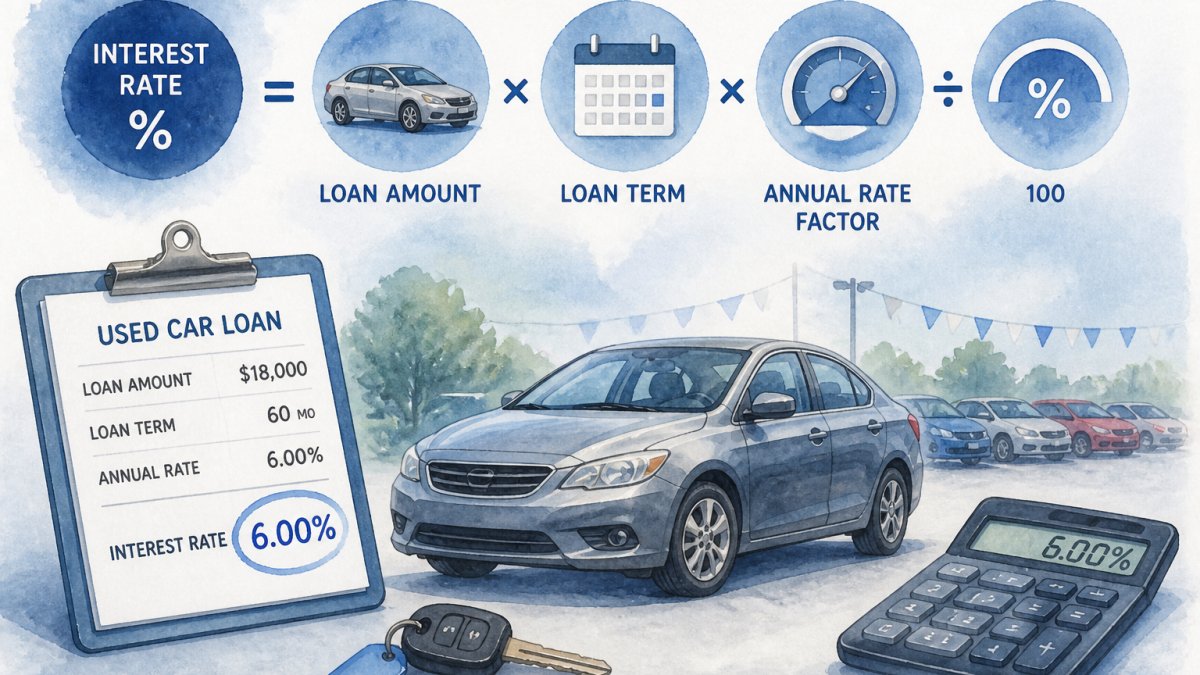
Monthly interest = remaining loan balance × (APR ÷ 12)
Three inputs drive every number on your contract:
- Loan amount: the vehicle price minus your down payment and trade-in value
- Interest rate: the annual percentage rate, or APR
- Loan term: the number of months you'll make payments
Get those three right and everything else follows.
The Formula for Total Interest on a Car Loan
The standard formula for total interest on a car loan is the amortization formula. It solves for a fixed monthly payment, then multiplies that payment by the number of months to find your total repayment. Subtract the amount financed and you have total interest.
The monthly payment formula looks like this:
M = P × [r(1 + r)^n] ÷ [(1 + r)^n − 1]
Where:
- M = monthly payment
- P = principal, the amount financed
- r = monthly interest rate, which is your APR divided by 12
- n = number of payments, which is your loan term in months
Then: Total interest = (M × n) − P
That's the whole calculation. Every auto loan calculator online runs this same math. Once you can do it by hand, you can spot a bad offer in seconds.
One warning before you go further. Watch out: a lower monthly payment does not mean a cheaper loan. Stretching the term lowers M but raises total interest, sometimes by a lot. If you want to shrink what you pay each month without inflating the total, these ways to lower your used car monthly payment cover the levers that actually work.
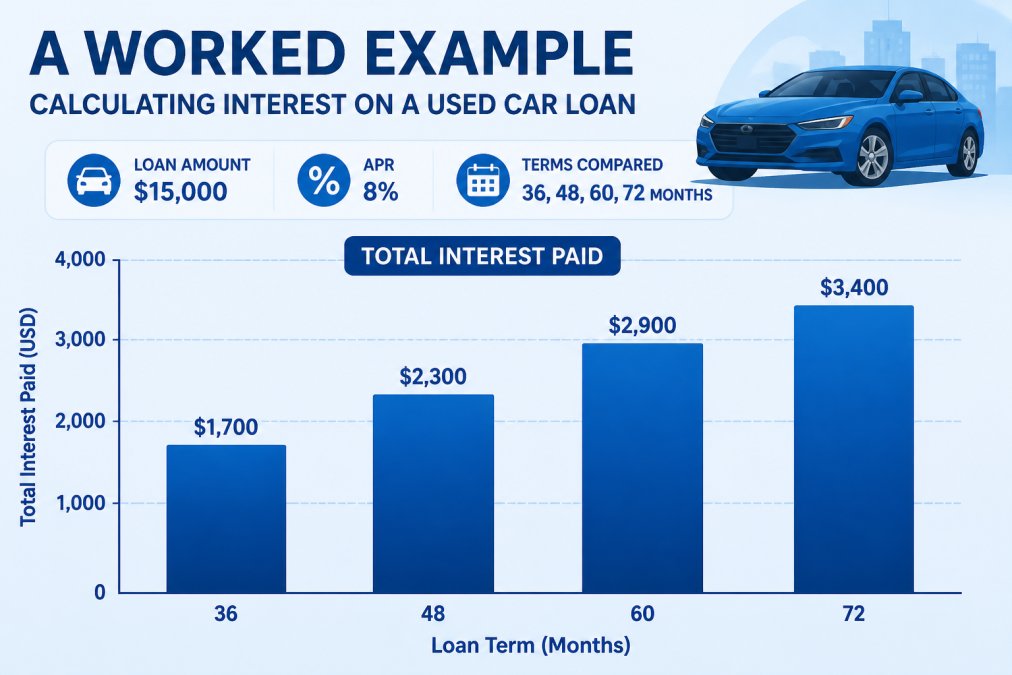
A Worked Example: Calculating Interest on a Used Car Loan
Say you're financing a used car with a purchase price of $15,000. You put $2,000 down, so the amount financed is $13,000. The lender quotes 8% APR over 60 months.
Convert the rate first: 8% ÷ 12 = 0.006667 per month.
Plug it into the formula:
- M = 13,000 × [0.006667(1.006667)^60] ÷ [(1.006667)^60 − 1]
- M ≈ $263.61 per month
- Total repayment = $263.61 × 60 = $15,816.60
- Total interest = $15,816.60 − $13,000 = $2,816.60
Now change one input. Stretch the same loan to 72 months and the payment drops to roughly $227.83, but total interest climbs to about $3,403.76. You save about $36 a month and hand the lender roughly $587 more over the life of the loan.
That trade-off is the whole game. Once you've run your own numbers, the next step is pushing back on the terms themselves. Our guide on how to negotiate used car financing terms covers what to ask for and when to ask.
Here is how the same $13,000 financed at 8% APR plays out across two loan terms.
| Loan term | Monthly payment | Total interest |
|---|---|---|
| 60 months | $263.61 | $2,816.60 |
| 72 months | $227.83 | $3,403.76 |
How to Calculate Used Car Loan Interest Rates With Taxes and Fees
Most buyers calculate interest on the sticker price and get a shock at signing.
Interest rate vs. APR. The interest rate is the cost of borrowing the principal only.
Which fees get financed. Not every charge belongs in the loan. A useful split:
- Usually financed: sales tax, title and registration, documentary fee, and any lender origination fee. These raise the amount financed and therefore the interest you pay on them.
- Usually paid upfront: down payment, and often add-on products like extended service contracts or gap coverage, which you can decline or pay separately.
- Always question: dealer-prep or reconditioning charges already baked into the price, and any fee the dealer cannot itemize.
The order of operations, with the math shown.
- Start with the negotiated vehicle price.
- Add sales tax. Your state sets the rate, and trade-in credit rules vary by state, so check your state motor vehicle agency for the exact figure.
- Add title, registration, and doc fees.
- Subtract your down payment and trade-in value.
- The result is your amount financed. Run the payment formula on that number, not the sticker price.
A simple example shows the effect. A $15,000 car with $1,200 in tax and financeable fees and a $2,000 down payment finances $14,200, not $13,000.
The APR check you can do yourself. Once you have the contract, divide the total finance charge by the amount financed, then annualize it roughly by dividing by the term in years.
Watch out: rolling negative equity from a prior loan into a used car loan raises the amount financed above the vehicle's value, which can push you past a lender's loan-to-value limit and into a higher rate tier, or a denial.
Not every fee belongs in the loan. Our breakdown of used car dealership fees explained clearly separates the legitimate charges from the ones worth questioning before you sign.
Using a Used Car Loan Interest Calculator
A used car loan interest calculator does the formula above for you. The value is speed and comparison: you can test five rate-and-term combinations in the time it takes to do one by hand.
Enter these fields in order:
- Vehicle price: the negotiated price, not the listed price
- Down payment: cash plus trade-in value
- Trade-in value: get this in writing before you start comparing
- Sales tax rate: your state's rate for your county
- Loan term: try 36, 48, 60, and 72 months side by side
- Interest rate: start with a rate estimate, then update it once you have a real offer
How to estimate a rate before you apply. You do not need a hard pull to bracket your likely rate:
- Pull your credit report and note your score range.
- Check whether the vehicle fits common lender age and mileage cutoffs.
- Gather two or three lender quotes, many prequalify with a soft pull that does not affect your score.
- Compare the APRs, not the note rates, and confirm the term and LTV the quote assumes.
Treat any estimate as a bracket, not an offer. A rate table tells you where you might land; only a lender can quote you after reviewing your file.
Compare on the same day, with the same inputs. Run every offer through the calculator with the same down payment and term, and compare total interest, not monthly payment.
Watch out: a calculator that defaults to a new-car rate will understate your used-car interest, check that the rate you enter reflects used-car pricing for your vehicle's age and mileage, not a promotional new-car APR.
One habit separates careful buyers from the rest: run every offer through the calculator on the same day, with the same down payment, and compare total interest, not monthly payment.
Reading a Car Loan Amortization Schedule
A car loan amortization schedule is a table showing every payment split into principal and interest, plus the remaining balance after each payment. It is the single best way to verify a lender's math before you sign.
Ask the lender for it in writing. Then check three things:
- Payment one interest: it should equal the amount financed × (APR ÷ 12). If it doesn't, something changed.
- The principal column: it should start small and grow every month.
- The final balance: it should hit zero on the last payment, not before or after.
Most auto loans use simple interest, which accrues daily on your remaining balance (What's the difference between a simple interest rate and precomputed interest on an auto...). That means payment timing matters. Pay a few days late and you owe a little more interest. Pay early or add to the principal and you owe less. The schedule shows you exactly how much.
If you want the full picture of how financing fits together from shopping to signing, our complete guide to financing used cars walks through the whole process.
Getting a Personalized Rate Estimate at Silverton Motors
Published rate tables are a starting point, not your rate. Your credit history, income, down payment, vehicle age, and mileage all move the number, and a lender can only quote you after reviewing your file.
Lenders evaluate your credit profile, budget, and the vehicle you're considering, and the offers you receive should be compared on equal terms. To move from an estimate to a real offer, follow the step-by-step pre-approval process.
Lenders typically ask for a driver's license, proof of income, proof of residence, your down payment amount, and trade-in title and payoff information if you have a trade.
Frequently Asked Questions
How do you calculate the interest rate on a used car loan?
Start with the amount financed, which is the vehicle price plus taxes and fees minus your down payment and trade-in value. Use the formula I = P x r x t, where P is the amount financed, r is the monthly interest rate (APR divided by 12), and t is the number of months. For example, a $15,000 used car loan at 8% APR for 60 months gives a monthly rate of 0.00667, and 15000 x 0.00667 x 60 = $6,000 in total interest.
What is the difference between APR and the interest rate on a car loan?
The interest rate is the percentage a lender charges on the principal balance. APR includes that rate plus certain fees, such as origination charges, so it reflects the true yearly cost of borrowing. A used car loan might advertise 7% interest but carry an 8.2% APR after fees. Always compare offers using APR, and check whether the fees are already included in the amount financed.
How do I calculate a used car payment with taxes and fees?
Add the sales tax for your state and any title, registration, and dealer fees to the vehicle price. Subtract your down payment and trade-in value to get the amount financed. Then apply the payment formula: M = P x [r(1+r)^n] / [(1+r)^n - 1], where P is the amount financed, r is the monthly rate, and n is the number of payments. A used car loan interest calculator handles this arithmetic for you.
How can I compare used car loan offers on equal terms?
Ask each lender for the APR, the amount financed, the loan term in months, and the total repayable amount. Use the same loan amount and term for every quote so the numbers are comparable. Check whether fees are rolled into the loan, and request a sample amortization schedule. Comparing total interest and total repayment, not just the monthly payment, shows which used car loan costs less over time.
The math in this article is the easy part. The hard part is getting a lender to look past a thin or bruised credit file and quote you a fair rate. That's the work we do at Silverton Motors. Our team reviews your credit profile with you, matches you to vehicles in our Toms River inventory that fit your budget, and structures the deal around a payment and term you choose with your eyes open. Browse our used cars, trucks, and SUVs, then apply online and get started with Silverton Motors.