 how-to
How to Inspect a Used Car for Hidden Water Damage
Last Updated: November 4, 2026
Quick Summary
Run a flooded car VIN check through a vehicle history report to look for flood or salvage title brands, insurance total-loss records, and registration gaps in storm-hit states. Then inspect carpets, seat belts, wiring, and the spare-tire well for mud, musty odors, and corrosion that reveal hidden water damage.
- Press your palm into every footwell carpet; it should feel dry and smell neutral.
- Pull every seat belt fully out and check for stained, stiff, or water-marked webbing.
- Look for tide lines, mud, or corrosion on the firewall, fuse box, and low-mounted modules.
- Saltwater is the worst case because it attacks wiring and connectors long after drying.
- Walk away from mud under carpets, interior metal corrosion, or a VIN mismatch.
Table of Contents
- Start With a Flooded Car VIN Check Before You Touch the Paint
- Walk the Exterior and Cabin for Visible Water Damage Clues
- Inspect Seat Belts, Upholstery, and the Spare-Tire Well
- Look for Signs of Water Damage in Car Engine and Electrical Systems
- Book a Professional Pre-Purchase Inspection Before You Commit
- Weigh the Water Depth, Duration, and Saltwater Risk
- Decide Whether to Walk Away or Proceed
- Schedule a Pre-Purchase Inspection at Silverton Motors
- Frequently Asked Questions
Start With a Flooded Car VIN Check Before You Touch the Paint
A flooded car VIN check is the fastest way to learn whether a used vehicle has a water damage history, and it costs far less than the repairs a submerged car will eventually need. Below, we'll show you exactly how to inspect a used car for hidden water damage, step by step, from the VIN to the test drive.
The first rule: never trust a freshly shampooed carpet. Sellers clean up water damage. Records are harder to scrub.
Read the Vehicle History Report for Flood and Salvage Records
Start with the vehicle identification number, or VIN. You'll find it on the driver's side dashboard near the windshield and on the door jamb sticker.
Run that VIN through a vehicle history report. Look for these red flags:
- A flood title or salvage title brand
- Insurance total-loss records
- Registration gaps in states hit by major storms
- Auction listings from disaster areas
A vehicle history report is a documented record of a car's title brands, insurance claims, and registration events, pulled using the VIN. It is a starting point, not a guarantee. Reports miss cars that were cleaned up and retitled without an insurance claim.
Verify the VIN and Watch for Title Washing
Title washing is the practice of moving a flood-damaged car through states with looser title rules to erase the flood brand. The car comes out with a clean title and a wet past.
Check that the VIN on the dashboard matches the VIN on the door jamb, the title, and the history report. Mismatches mean walk away. A title that was reissued in another state shortly after a major storm deserves a hard look.
Walk the Exterior and Cabin for Visible Water Damage Clues
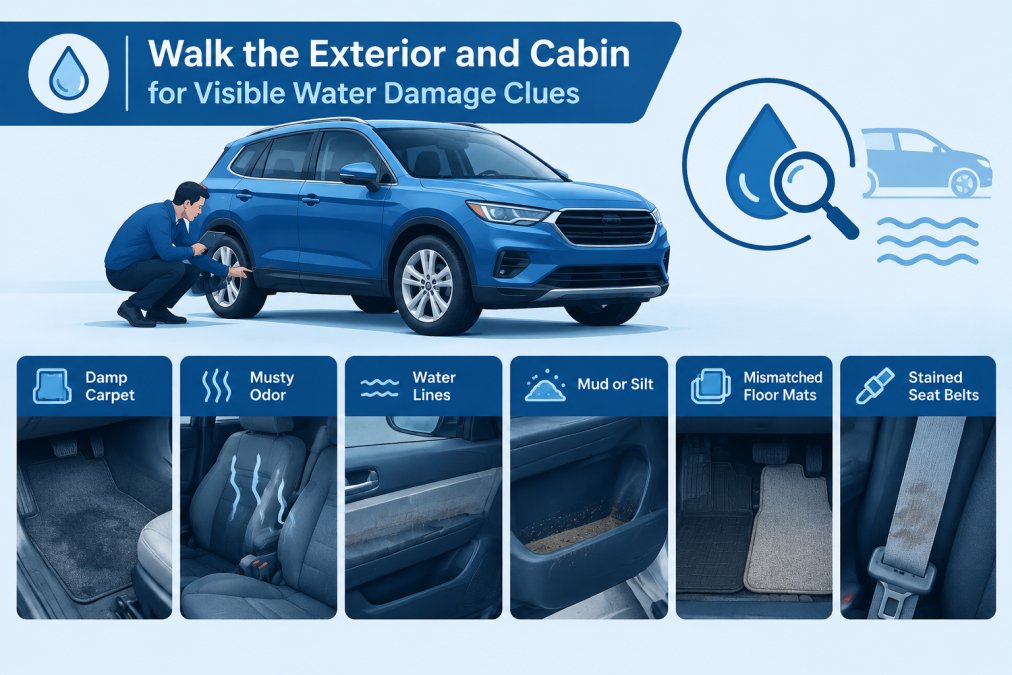
Visible water damage clues show up in the cabin first. Open every door, pull the mats, and get your nose and eyes close to the carpet.
Check Carpets, Floor Mats, and Padding for Dampness
Press your palm into the carpet in every footwell. It should feel dry and smell neutral.
Watch for:
- Damp carpet or spongy padding underfoot
- Floor mats that look newer than the rest of the interior
- Carpeting with a different shade or texture than the door panels
- Water stains or tide marks near the sill plates
Mismatched materials are a tell. Sellers replace soaked carpet and padding but rarely match the original perfectly.
Sniff for Musty Odors and Look Under Carpets and Door Panels
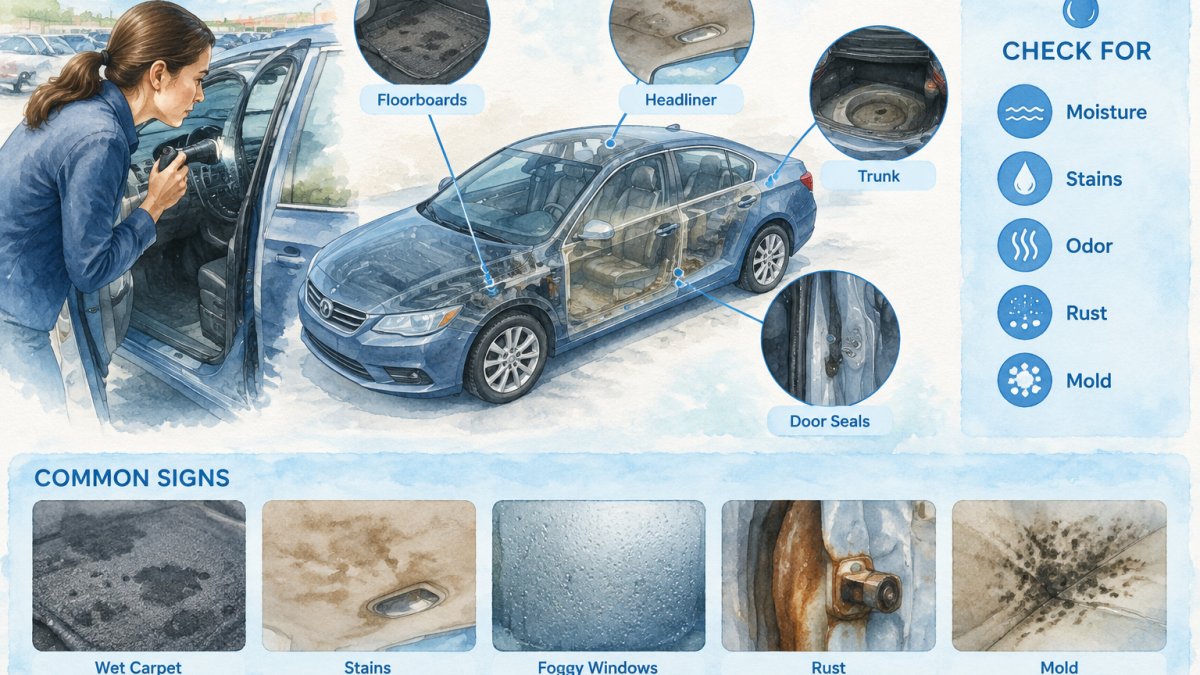
A musty odor or mold smell is one of the most reliable signs of past submersion. Close the windows, let the car sit in the sun, then open the door and breathe in.
Then look lower:
- Lift the carpet edge near the door sills and check for mud, silt, or grit
- Pull the door panels back slightly and look for water residue or staining
- Check the trunk and spare-tire well for rust rings or dampness
Cleanup crews miss these spots. That's exactly why they're worth checking.
Inspect Seat Belts, Upholstery, and the Spare-Tire Well
Pull every seat belt all the way out. Stained, stiff, or water-marked webbing is a warning sign. So is a belt that looks brand new in an older car, which can mean a replacement after flooding.
Check the upholstery for uneven fading, loose stitching, or a smell that gets stronger near the seats. Then open the trunk and lift the spare-tire cover. Rust, corrosion, and damp padding in the spare-tire well point to water that sat in the lowest part of the car.
Look for Signs of Water Damage in Car Engine and Electrical Systems
Signs of water damage in car engine bays are subtler than a stained carpet, but they matter most because the expensive failures show up months later. Pop the hood and look for water lines, mud, or dried residue on the engine compartment walls, the firewall, and the wiring looms. A tide line on the firewall or inner fender is a depth marker: note how high it sits relative to the hood latch, the fuse box, and the battery tray.
Then work through these electrical touchpoints:
- Electrical connections with green or white corrosion, especially at grounds bolted to the body
- Fuses and relays with rust, moisture, or a fogged fuse-box lid
- Headlights and taillights with condensation inside the lens or water lines on the reflector
- Wiring harnesses with cracked, stiff, or chalky insulation, or looms that have been re-taped
- Control modules and connectors mounted low in the cabin, under the seats, or behind kick panels
- The OBD-II port and the connectors behind it for corrosion or bent pins
Why Modern Electronics Fail After the Car Dries
A modern vehicle carries dozens of computers: the engine control module, transmission control module, body control module, airbag module, and assorted sensors and relays. Water rarely kills them outright. Instead it wicks into sealed connectors, sits against pins, and starts corrosion that raises resistance over weeks or months.
A common pattern is failure at the lowest-mounted modules and grounds first, because that is where water pools. Wiring harnesses routed through the floor sill and under the seats are prime candidates. If a seller has recently replaced a body control module or a seat-mounted sensor in an older car with no accident history, ask why.
Check the Underbody and Scan for Stored Codes
Put the car on a lift or ramps if you can do so safely, and look at the floor pan, subframe, and exhaust hangers for rust scale, corrosion on fasteners, and mud packed into crevices.
Pending codes and module communication errors are the fingerprints of water intrusion that has not yet set a hard fault. For a deeper look at engine condition, see our guide on how to inspect used engine health.
Watch out: a seller who has just detailed the engine bay and re-taped the harnesses may be hiding exactly the residue you are looking for, so inspect before any cleaning is done or ask for photos taken before the detail.
Book a Professional Pre-Purchase Inspection Before You Commit
A professional pre-purchase inspection is the step that catches what you can't see.
Ask the shop to check for water intrusion specifically. Not every inspection covers it by default.
If you're ready to arrange one, our step-by-step pre-purchase checking process walks you through the full sequence.
Weigh the Water Depth, Duration, and Saltwater Risk
Not all water exposure is equal. Three factors decide how much risk you're taking on:
| Factor | Lower Risk | Higher Risk |
|---|---|---|
| Water depth | Below the floor pan | Above the seats or dashboard |
| Duration | Brief splash or rain leak | Hours or days submerged |
| Water type | Freshwater | Saltwater or muddy floodwater |
Saltwater is the worst case. It attacks wiring, electrical connections, and metal fasteners long after the car dries. Freshwater submersion still damages carpeting, padding, and electronics, but the corrosion clock runs slower.
Duration matters too. A car that sat in water for days has soaked padding, connectors, and modules. A car that caught a splash may only need drying.
Decide Whether to Walk Away or Proceed
Use a three-tier framework instead of a gut call. Sort what you found into hard stops, conditional proceed, and clean.
Walk away, no negotiation. Treat these as disqualifying:
- A flood title or salvage title brand, or a title that was reissued in another state shortly after a major storm
- Mud or silt under the carpets, in the door panels, or in the spare-tire well
- Corrosion on interior metal, seat frames, or electrical connections
- A musty odor that returns after the car sits closed in the sun
- A VIN mismatch between the dashboard, door jamb, title, and history report
Proceed only with conditions. Minor clues, a damp floor mat, a single fogged taillight, a carpet that looks newer than the rest of the interior, are not automatic disqualifiers, but they require a professional inspection sign-off and documented disclosure from the seller before you agree on terms. Put the condition in writing: the sale is contingent on a pre-purchase inspection that specifically checks for water intrusion.
Proceed. Dry carpets, matching materials, clean history, no stored codes, and no residue on the underbody.
Treat a Clean Report as a Starting Point, Not Proof
A clean history report and an unbranded title are not evidence that a car stayed dry. Reports depend on insurance claims, title brands, and reported events; a car that was cleaned up and retitled without a claim can pass through with no record. Ask directly whether the car has ever been in a flood, and get the answer in writing.
If You Find Damage After Purchase
Document everything before you call anyone: preserve the listing and photos, save the messages and the signed buyer's guide, keep the inspection report, and photograph the damage with the odometer visible. Then raise it with the seller in writing and keep a dated record of every contact. Remedies depend on your state's consumer protection and used-car disclosure rules and on whether the seller made a written representation.
At the decision point, our complete used-car buying guide helps you weigh next steps. And if you're comparing history reports, this breakdown of CARFAX vs AutoCheck shows which one surfaces flood records more clearly.
Schedule a Pre-Purchase Inspection at Silverton Motors
Buying a used car shouldn't feel like a gamble. At Silverton Motors, we keep a stocked lot of used cars, trucks, and SUVs. Our team can answer questions about any car on the lot.
Get started with Silverton Motors and shop with a clearer picture of what you're buying.
Frequently Asked Questions
What are the most common signs of a flooded car?
The most common signs include a musty or moldy odor in the cabin, damp or mismatched carpeting and floor mats, water lines or silt in the door panels and trunk, stained or unusually new seat belts, and rust on interior metal fasteners. Under the hood, look for mud residue, corrosion on electrical connections, and condensation in the headlights or taillights. A flooded car VIN check and a vehicle history report can confirm whether flood or salvage records exist.
Can a mechanic tell if a car has been flooded?
Yes. A professional pre-purchase inspection gives a mechanic the tools and access to check areas you cannot easily reach, including under the carpet padding, inside door panels, the spare-tire well, and the engine bay wiring. They can spot corrosion on electrical connections, water residue in the frame, and signs of recent shampooing that mask odors. A mechanic inspection is the most reliable way to detect hidden water damage before you buy.
How do I check a car's history for flood damage?
Start with a flooded car VIN check using the vehicle identification number from the dashboard and driver's door jamb. Order a vehicle history report and look for flood, salvage, or water damage records, plus title branding in other states. Cross-check the VIN on the title and the car itself to catch title washing. Reports have limits, so combine them with a hands-on inspection and a mechanic's pre-purchase inspection.
Is it safe to buy a car that has had water damage?
It depends on the water depth, duration, and whether the water was fresh or saltwater. Saltwater and deep submersion often cause delayed electrical faults, corrosion, and mold that may not appear for months. A car with a flood title should be treated with caution, and you should factor in the risk of intermittent faults in wiring and electrical systems. If you proceed, get a professional pre-purchase inspection and document the seller's disclosure in writing.